
電影訊息
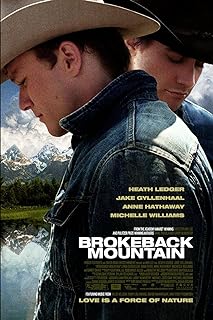
斷背山--Brokeback Mountain
編劇: E. Annie Proulx Larry McMurtry
演員: 傑克葛倫霍 希斯萊傑 蜜雪兒威廉絲 安海瑟薇
断背山/断臂山
 7.7 / 417548人
134分鐘
7.7 / 417548人
134分鐘
編劇: E. Annie Proulx Larry McMurtry
演員: 傑克葛倫霍 希斯萊傑 蜜雪兒威廉絲 安海瑟薇
電影評論更多影評

2010-11-28 19:14:57
Decoding the Myths across the Mountains: An Analysis of Brokeback Mountain Using
[All right reserved, any unauthorized reproduction or transfer is prohibitted]
This essay includes four decoding parts to interpret the visual motifs, the character traits, the story and etc. in Ang Lee’s Brokeback Mountain by the means of semiotics and psychoanalysis. In each part, I will use one key material or key scene to present the ideas about the focused point for that part.
I. A preview: the basic signs in Brokeback Mountain
Key material for illustration: the film poster
A film poster is definitely not just an independent product but accorded with the visual motifs in the whole motion picture all along. In order to analyze the film step by step, let’s start with the interesting film poster first. Now we』ll use semiotics to interpret the elements in the poster as signs to skim off the different messages it contains.
A. Firstly, it’s not hard to find out the denotations of the signs:
Background: blue sky with a large cloud, a mountain range and a forest, the reflections of the mountains and the forest in a river;
Protagonists: Two young men in denim jackets and hats looking downwards and facing away from each other.
B. Secondly, 「myths」 in the poster also tell us a lot. The signs used for this poster hold a range of connotations as the following items (even can be listed more):
Mountains, forests and lakes are specifically related to vast, open countryside, which connotes not only nature, but also freedom.
The costumes seem to indicate a western genre film. However, some other signs used are not like a western. For example, the colors associated with a western are gold and brown as the landscape used is often a desert.
The facial expressions of the characters are serious, gloomy and the way they look down connotes some problems – maybe a conflict, shame or sorrow as far we still don』t know. The way they are positioned suggests that the conflict is between them but it is not a conflict based on anger and violence as they are positioned close together.
II. In a symbolic manner: their growing desire and heterogeneousness
Key scenes for illustration: protagonists』 mutual gazing
A. Scopophilia- the growing desire
The desire that comes from libidinal energy is deep inside their mind that they are even unconscious about it. But the film still can make it screened by the means of symbolic. In the selected parallel segment, the mutual gazing indicates the growth of the silent physical and emotional attraction between them.
As for Scopophilia, there are several points as symbolic related in this scene.
At the beginning of herding life on Brokeback Mountain, we see the beautiful sunset and golden clouds as if we see their golden years with enthusiastic. But when the night draws near, Jack is staring at Ennis’s campfire in the distance, smoking in the cold light of the full moon. We can read his loneliness, his curiosity about Ennis, and also his desire for his com-pany from the close-up face shot. Later in a day scene, just like an echo, when hears thunder, Ennis looks up at the heights of the mountain above him, seeing Jack riding amid the herd with the clouds of storm beyond. Again, a close shot of Ennis’s face conveys a sense of con-cern (Patterson 14). Actually, when they are watching each other across the far distances of the mountain, the image itself as a sign in a symbolic manner has built up the connection be-tween them.
Another important shot of gazing in this mountain life sequence is, when Ennis is tak-ing a bath, Jack averts his gaze from naked Ennis (Greven 224). His eyes subtly flicker as if he has the unconscious of seeing and unseen. This close-up shot also can be seen as symbolic to connote the scopophilia desire for Jack.
By the means of semiotics, these images themselves have represented those desires can』t be seen without a word.
B. Mountain- Iconic, symbolic and indexical
In this mountain life scene, the Brokeback Mountain plays an important role. We notice that, the mountain comes up many times in the film in various forms of the real landscape, a postcard picture, the only place they can be together, the precious memory in their hearts and so on. The director Ang Lee put forward the idea that the mountain itself is an essential role which is a sign to symbolize their long and disillusion for love (Dahan 53).
Actually the Mountain is an iconic, then a symbolic and an indexical in their mind. Obviously it’s an iconic since it’s shown in the postcard afterwards; it’s a symbolic since it gradually becomes their habitual connection; it’s also an indexical since it causes effects to them. It represents the emotion in a visual object form, even audible when they refer it in their dialog, and eventually a symbolic of the eternal love. How can this sign work for the film?
According to de Saussure, signs only make sense as part of a formal generalized and abstract system. Meaning is produced by a system of Difference between signifier and signi-fied(s). As for the meanings of the mountain, it’s quite different from another sign in the film- a town called Signal. If put them together, we can find the big contrast: the town in a fading color represents the closed space, the limitations while the mountain represents freedom, open space and clarity, wonderful sense of liberation. The script writer Diana Ossana once mentioned that, the mountain is a space that allows them to have sexual and emotional free-dom for the first time of their lives (Dahan 86). However, when they go downhill to get the town, all the happiness of life vanish away.
Through this contrast and difference, we understand that, to them, the Brokeback Mountain is not just magnificent landscape but an escape into nature as a refuge from socie-ty’s ignorance and brutality; it also indicates the naturalness of their desire.
C. Sheep- the cowboys are heterogeneous
Sheep is another sign in the mountain scene. The sheep represent society and commu-nity, as the animal that God loves most in the Garden of Eden. They always ride horses amid the herd, implying that they are heterogeneous to them, also to the society.
After their first sexual encounter, the death of the sheep by a coyote’s attack signifies their deviation from society and community, their violation of societal norms, and resembles their blasphemy to God and potential annihilation, to which they will feel shameful of and pay the cost. Sheep are offered as a sacrifice in the process of a Christian rite, which symbo-lizes that they doom to be the victims (Patterson 124). Sheepskin is cut open, which symbo-lizes their secrets ought to be unveiled. The dead sheep can also be associated with the killed gay in Ennis’s memory.
In this symbolic way, Ennis’s and Jack’s heterogeneousness is shown, which impacts the audience unconsciously.
III. Reticence and violence: repression of Ennis’s desires
Key scene for illustration: childhood memory of Ennis
Four years later, when they meet again and have a post-motel weekend trip, Ennis tells the story of his witness of a man killed for being gay, during a nighttime campfire.
A. The full moon- their desire to stay together
Almost every time Jack and Ennis are together at night, there is the full moon. The full moon signifies emphasize that only when they meet and belong to each other, can they feel their life real and complete.
B. Trauma- reticence and violence
In the Oedipal stage of Ennis, his father set up the Symbolic Order. According to Lacan, father represents the fact that a wider familiar and social network exists. The witness of a dead gay is absolutely a trauma for him. Deep inside him, he has phobias about the trauma, upset and anxious about his sexual orientation which he knows is not allowed by the west world. So his identification is rough with many conflicts. As for Ennis’s mind, he is con-strained by poverty, under education, homophobic culture; 「you know that I ain』t queer」 (Proulx 20) , and he doesn』t identify himself as 「homosexual」 in order to escape from the violent attack and murder trauma that has haunted him since his childhood.
As Ennis says, 「If you can't fix it, you gotta stand it (Proulx 54)」; he is reticent. According to Freud, the unconscious is produced by the very act of repression. When he has no choice but to be affected, to hide his true feelings and to repress his ego, he even needs violence to deal with the external world. In his unconsciousness more feared he is, in the real world more violent his is. In his mind, he is just a little boy filled with terror while his appearance should be an ordinary cowboy. Heath Ledger interpreted his role that Ennis can hardly express his love to the others because he is always struggling against his genetic combination and the conventional values derived from his father (Dahan 90). So when Ennis can't be reticent, the only way for him to express his emotion is violence. Having internalized his sense of toughness and ag-gression, Ennis later always fights back against the others in a violent way. This is significant, as his social identity is mostly subordinate and inferior throughout the film.
IV. The nestled shirts: symbolic acceptance in silence
Key scene for illustration: finally Ennis found their two shirts nestled in Jack’s cup-board.
A. Shirts- symbolic
As referred a little about costumes in part I, Ennis’s costumes are almost in brown, the color of earth, which conveys his suppression. As a symbolic, Ennis’s shirts are all plaid or striped, which signifies his mind is always being constrained, while Jack’s are in pure colors, free at heart.
What’s more important, the two shirts nestled in this scene are the symbolic extensions of Ennis and Jack, heightened by the fact that they』re soaked with sweat and blood. To use one’s own shirt to cover another’s signifies the desire to manipulate, absorb the other and the external world into oneself on a fantastical level.
B. The blue- love and ceremony
Colors are signs too. Through the costumes, we know that blue stands for Jack while brown (as the color of earth) for Ennis. Jack’s shirt and car are blue, similar color tone to the skies of Brokeback Mountain. Ennis’s eldest daughter has her earrings in blue, noticeable in an image of last sequence. So do the tents they use for gathering on the mountain, the flowing river aside and sky over head, which blue symbolizes freedom and naturalism. Blue signifies not only the romance but also all the beloved of Ennis.
After the two shirts scene, as the ending, Jack’s mother is in blue, and some furniture is blue. Although it seems that the surroundings inside the house are tend to fade into white, blue is still the major. When she helps Ennis put her son’s blue shirt into his brown kraft paper bag, a 「ceremony」 with special meanings completes: her acceptance for the love between her son and another man, silently but confirmedly.
Conclusion
As for us, the Brokeback Mountain will always remain a myth even though we tried to interpret, to decode everything about it using semiotics and psychoanalysis which are such scientific and rational methods. After this cinematic identification, we seem to get closer to the myth but still far away from the mountain, the romance. I consider it the magic to drive the audience watch or think it over again and again. The magnificent visual designs, the psy-chological states of characters and so on about the film deserve to be remembered. What also touches us is the earnest emotion, which would never be tedious for us to analyze in whatever form of semiotics, psychoanalysis or others.
Works Cited
Dahan, Li. A Journey of Ang Lee: from Brokeback Mountain to Lust, Caution. Taipei: As If Books, 2007.
Greven, David. 「Narcissus Transfigured: Brokeback Mountain」. Manhood in Hollywood from Bush to Bush. Austin: University of 德州 Press, 2009. 278-240.
Patterson, 艾瑞克. On Brokeback Mountain: meditations about masculinity, fear, and love in the story and the film. 瑪莉land: Lexington Books, 2008.
Proulx, Annie, Larry McMurtry, and Diana Ossana. Brokeback Mountain: story to screenplay. 紐約: Scribner, 2005.
Unknown. Brokeback Mountain Film Poster, 2005.
.
評論