
電影訊息
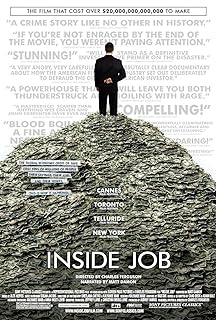
黑金風暴--Inside Job
編劇: Chad Beck Adam Bolt
演員: 麥特戴蒙
监守自盗/呃钱帝国(港)/幕后黑手(台)
 8.2 / 82776人
105分鐘
8.2 / 82776人
105分鐘
編劇: Chad Beck Adam Bolt
演員: 麥特戴蒙
電影評論更多影評

2015-01-17 07:03:13
How Does Capitalist Shape the Law
很喜歡legal study 課推薦的這一部紀錄片 寫了一個reaction paper 稍稍上傳一下作為影評吧。
Karl Max made his sharp observation that the society consists of two uneasy groups with incompatible economic interests. The ruling class, using laws to serve their needs, continues to hurt the interests of the ruled members of the society. The movie 「Inside Job」 unveils the masks of those powerful businessman and politicians in the US, and shows us how they led to the catastrophic outbreak of credit crisis step by step. Millions of people suffer from lingering impact of the financial crisis, but many of those who plot the crisis were hiding from the camera and counting the money they secretly gained.
Laws, instead of acting as the common interests of all, act as the tool of capital class to serve their needs. The capitalist dictates laws in their interests and even change the old laws that served to protect the benefits of general investors. In order to help Citigroup and Travelers merge to form Citigroup, Greenspan helped pass the new law to facilitate this merger of the largest financial service group, and even gave them one-year exemption. Though this merger clearly violated the Glass-Steagall Act that prevented the bank with consumer deposits from engaging in risky investment- banking activities, bankers along with politicians in power managed to accomplish it finally. As the result of their combining effort, soon the pass of Gramm-Leach-Bliley Act by the congress overthrew the Glass-Steagall Act, and cleared the way for future mergers. People foresaw this might cause future danger, but the profit-driven bankers and politicians continued the building of large firms.
Even when the state tries to regulate capital, capitalists find ways to avoid it. The cunny bankers later on introduced the new popular item 「derivative」 ---a new financial tool with even bigger instability---to the industry. The Commodity Future Act of 2000 exempts the derivatives from strict regulation, and the great government officials who supported the act later gained enormous personal wealth from derivative. The lack of regulation piled up great danger. Furthermore, the ill-use of leveraging tools in investment banks created huge bubbles. But banks didn』t care that the money they borrowed had ridiculously transcended their own assets value as long as they could still sell CDOs to investors to made profits. The common investors were further deceived by the rating agencies which gave very low valued CDOs 「 AAA」 ratings. None of these institutions were under strict supervision, and thus none of them admitted it should be their fault to take on the responsibilities of 「lying」. They smartly circumvented the legal accusations on 「giving false information intentionally to the investors」, and claimed these predictions and evaluations were all 「opinions」. Finally, CDO market collapsed in 2007, and banks went bankruptcy, but many of the executives of insolvent companies can still walk away with their personal wealth intact.
評論